




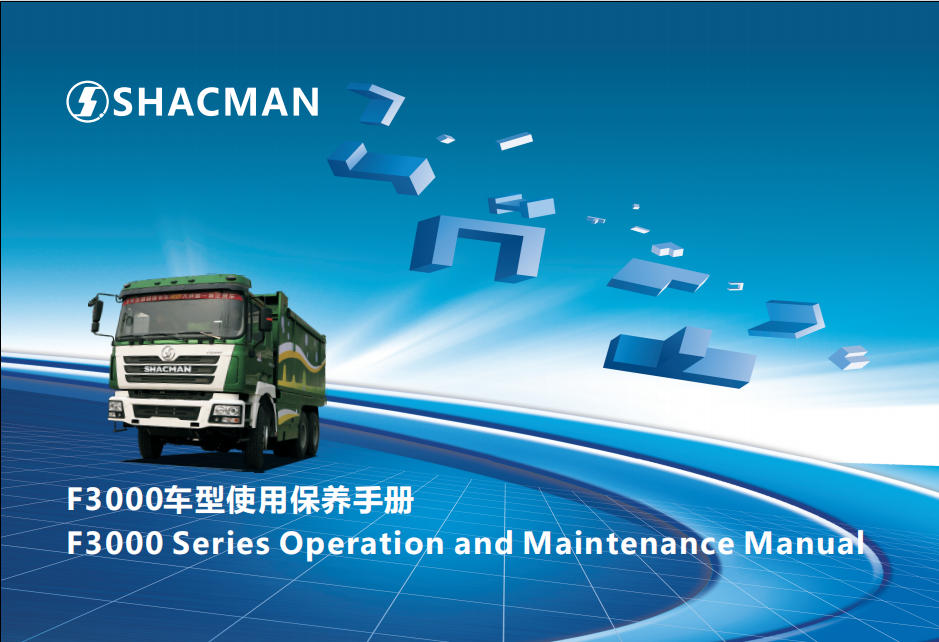
Maintenance Manual for Shaanxi Automobile F3000 Model
Maintenance Tips for SHACMAN F3000 Heavy‑Duty Truck
The SHACMAN F3000 is a widely‑used heavy‑duty truck series, covering tractors, dump trucks and cargo trucks. Its service life, driving reliability and fault frequency largely depend on proper daily operation and standardized maintenance. Many premature vehicle failures stem not from component quality defects, but from neglected pre‑trip inspections, missed scheduled maintenance, unauthorized modifications or improper operation. Based on the official F3000 Series Operation and Maintenance Manual, this maintenance guide is compiled for drivers and fleet managers.
I. Conditions Excluded from Factory Warranty
Please note that the manufacturer shall not be liable for vehicle failures under the following circumstances. Avoid these practices in daily operation:
- The vehicle nameplate, whole‑vehicle or chassis certificate is inconsistent with the physical vehicle, or the nameplate/certificate has been altered.
- The vehicle is operated improperly against manual requirements with rough driving habits.
- Scheduled maintenance including new‑vehicle running‑in service and mileage‑based maintenance is not performed at authorized service stations.
- Non‑factory‑specified engine oil, coolant, air filter, engine oil filter and other consumables are adopted.
- Troubleshooting and disassembly‑repair work are carried out without contacting official customer service after faults occur.
- Unauthorized vehicle modifications without manufacturer approval: cargo box enlargement, frame reinforcement, leaf‑spring thickening, oversized tire fitting, etc.
- Failures caused by non‑genuine replacement parts during repair.
- Continued driving with existing or hidden faults, resulting in secondary component damage.
- The vehicle has exceeded the quality‑assurance period.
- Failures caused by human factors other than material, design or manufacturing defects.
Reminder: Read the complete operation and maintenance manual carefully upon vehicle delivery and keep it on board. The manufacturer continuously improves vehicle products. Illustrations and descriptions in the manual are valid at publication. Technical updates may be implemented without prior notice. The manual is part of the vehicle and shall be transferred together with the vehicle upon resale.
II. New‑Vehicle Running‑in (Break‑in Period)
The specified running‑in mileage for the F3000 is 2000‑2500 km. The break‑in period directly determines the subsequent vehicle condition. Avoid overloading and aggressive driving.
- Do not rev the engine immediately after cold start. Wait until normal operating temperature is reached before acceleration.
- Prefer flat road surfaces. Shift gears timely, engage the clutch smoothly, and avoid sharp acceleration and emergency braking.
- Downshift in advance before climbing uphill. Prevent engine operation under low‑speed, high‑load conditions.
- Towing trailers is prohibited within the first 3000 km. The payload shall not exceed 70 % of the rated cargo capacity.
- Retorque wheel nuts to specified torque after the first 50 km of driving and after every tire replacement.
- Monitor engine oil pressure and coolant temperature constantly. Watch for abnormal overheating of transmission, front/rear axles, wheel hubs and brake drums. Stop for troubleshooting if overheating occurs.
- Remove the fuel‑injection pump limit block only after completion of running‑in. Removal during break‑in is strictly forbidden.
- Complete running‑in maintenance at an authorized service station with full‑vehicle inspection and oil‑change work to finish the break‑in procedure.
III. Mandatory Pre‑Trip Routine Inspection (Before Every Departure)
A dozen minutes of pre‑trip inspection helps prevent roadside breakdowns and major accidents. It constitutes basic driver responsibility.
- Main battery switch: Ensure the main power switch is switched on. Confirm cab locking; the dashboard will trigger an alarm if the cab is unlocked.
- Cooling system: Check coolant level. This vehicle is fitted with an aluminum radiator and requires heavy‑duty long‑life antifreeze complying with official specifications. Park the vehicle on level ground. When the engine is cold, the coolant level shall not fall below the observation port of the expansion tank. Top‑up coolant periodically. Never mix antifreeze of different types.
- Engine oil: Park on level ground. After engine cool‑down, pull out the oil dipstick. The oil level must sit between upper and lower marks (approx. 3 L volume between marks). Specified oil grade: CI‑4 15W‑40 diesel engine oil. Tilt the cab for engine‑oil filling.
- Brake fluid: Maintain brake‑fluid level between the “MAX” and “MIN” marks. The clutch hydraulic system uses DOT3 / HZY3 synthetic brake fluid. Replace brake fluid every 2 years or 180 000 km. Clean pipelines and replace fluid immediately if turbidity appears.
- Fuel: Never run the fuel tank completely dry. Bleed the fuel system if fuel is exhausted. For dual‑chamber‑tank models in cold regions, switch properly between different‑grade diesel fuels.
- Air filter: Empty and clean the dust collection cup every day in dusty or frigid environments. Damaged or loose dust cups cause poor sealing and early wear of the engine and turbocharger.
- Tires and wheel nuts: Inspect tire pressure and tire appearance.
- Lights and instrument panel: Verify function of all lamps, signal lights and dashboard alarm indicators.
- Air‑reservoir water drainage: Drain accumulated water from air reservoirs.
- Leakage check: Look for leaks in engine‑oil, coolant and air pipelines.
Correct Engine Start‑Stop Procedures
- After start‑up: Allow idling for 3‑5 minutes upon cold start. Do not rev harshly. Apply load only after oil pressure and oil temperature return to normal values.
- Before shutdown: Keep idling for 3‑5 minutes to let turbocharger speed drop before cutting off ignition. Never rev sharply before shutdown. Otherwise, the turbo rotor keeps spinning at high inertia while the oil pump stops supplying lubricant, easily burning bearings and sealing rings.
- Pre‑lubricate the turbocharger before restarting a long‑parked engine to avoid dry‑start wear.
Additional note: After engine start‑up, do not drive away until air‑reservoir pressure rises above 5.5 bar and brake‑circuit warning lights go out.
IV. Key‑System Operation Guidelines
1. Brake System
Four brake systems are equipped: service brake (foot brake), exhaust auxiliary brake, parking / emergency brake (hand brake), and optional trailer brake.
- The service brake adopts dual‑circuit air braking. If pressure in either air reservoir drops below 5.5 bar, warning lights illuminate. Stop immediately and search for leakage. With full air pressure, engine off and parking brake applied, total pressure loss shall not exceed 49 kPa within 2 hours.
- Exhaust brake: Highly useful on long downhill gradients, it reduces service‑brake usage and brake‑pad wear. Notes: Engine speed shall not exceed 2000 rpm; braking efficiency improves in lower gears. Neutral‑coasting with exhaust brake engaged is prohibited. Depressing clutch or accelerator cancels exhaust brake. Use cautiously on wet, icy or snow‑covered roads to avoid sideslip or fishtailing.
- Hydraulic retarder (optional): An auxiliary brake that cannot replace the main service brake. When descending slopes, keep engine speed ≥1500 rpm; downshift if necessary. Never engage retarder in neutral or with clutch disengaged. If coolant or oil temperature exceeds limits, the retarder automatically reduces braking torque or cuts out. Continuous flashing indicator lights indicate circuit faults. Rely on service brakes for emergency deceleration.
2. Differential‑Lock Operation (4×2 / 6×4 Models)
Wheel‑to‑wheel and inter‑axle differential locks improve cross‑country performance only when wheels slip or the vehicle is stuck.
‑ To engage: Bring the vehicle to a full stop, depress the clutch, then activate the differential‑lock rocker switch.
‑ Disengage immediately after escaping from slippery terrain. Driving on paved roads with differential locks engaged will severely damage driveline components.
3. Cab‑Tipping Operation
Tilt the cab for engine‑bay maintenance. Strictly observe safety rules:
- Before tilting: Remove loose articles inside the cab; close all doors; fully open the front radiator grille; shift transmission to neutral; chock wheels with wedges. For tractor‑semitrailer combinations, disconnect air and electrical connectors to the trailer.
- Keep personnel clear of the cab front area during tilting.
- After lowering the cab, confirm full engagement of the cab‑locking mechanism. The cab‑unlock warning lamp on the dashboard must go out. Do not drive with incompletely locked cab.
- Oil filling and air bleeding for the cab‑tilt hydraulic system can only be performed when the cab is fully lowered and locked.
4. Transmission‑Shifting Instructions (Single‑H / Double‑H FAST Gearboxes)
- Depress the clutch pedal fully during every shift for complete clutch disengagement, preventing premature synchronizer wear.
- Always select 1st gear or creeper gear “C” for full‑load take‑off. Creeper gear “C” applies only for uphill starts, full‑load launches and extremely rough terrain. Reverse gear and creeper gear can only be engaged at stand‑still.
- For Double‑H shifting: Do not skip gears when switching between high‑range and low‑range to protect auxiliary‑box synchronizers. Avoid lateral jostling of the shift lever while in neutral.
- Towing warning: Never tow the truck with transmission in neutral. Remove the propeller shaft for towing. Maximum towing speed ≤40 km/h.
5. Dual‑Chamber / Parallel Fuel Tanks (Cold‑Climate Option)
The auxiliary tank stores low‑cold‑resistance diesel for cold‑weather cranking, and the main tank holds 0# diesel for normal driving.
- Switch to the auxiliary tank before cold cranking. After the engine warms sufficiently, switch back to the main tank.
- Switch back to the auxiliary tank five minutes before stopping the engine, filling fuel lines with low‑grade diesel for easier next‑time cold start‑up.
- Bleed fuel lines if the engine fails to start after tank switching. Never drain fuel tanks completely.
- Under high‑temperature conditions, main and auxiliary tanks may use identical diesel grades to enlarge total fuel capacity.
V. Tiered Maintenance System: Routine, Class‑I, Class‑II, Class‑III, Class‑IV Maintenance
Maintenance categories include daily routine inspection, Class‑I, Class‑II, Class‑III and Class‑IV scheduled maintenance. Service intervals differ for normal‑duty and severe‑duty conditions.
Severe‑duty definition: Ambient temperature persistently above +30 °C or below −10 °C; fuel sulphur content 0.5‑1.5 %. Shorten oil‑change and maintenance cycles accordingly.
Major Maintenance Items
- Engine: Change engine oil and oil filter according to schedule; inspect and adjust valve clearance; replace fuel filter cartridges. The primary air‑filter element may be cleaned with compressed air. The safety filter element must be replaced and cannot be washed. Replace the safety element after every 5 cleanings of the primary element. For oil‑bath air filters, renew internal oil periodically.
- Driveline (transmission, transfer case): Check oil level; replace gear oil at specified intervals; clean breather devices.
- Drive axles (front & rear): Check axle‑housing oil level; replace gear oil; clean axle breather screw plugs; service wheel‑hub reducers. Certain hub‑bearing units are maintenance‑free for 500 000 km.
Axle oil‑change reference: Dump‑truck / composite versions: 30 000 km or 1 year; lightweight tractor / cargo‑truck versions: 60 000 km or 1 year.
- Suspension critical‑bolt retorquing
Retorque U‑bolts for leaf springs, thrust‑rod fasteners, air‑bag brackets and stabilizer‑bar brackets at 200 km and 500 km on new vehicles. Retighten all critical fasteners under loaded condition upon completion of running‑in (2500‑3000 km). During early‑stage regular service, retorque under full load every 200‑300 km for 2‑3 consecutive cycles, then follow standard maintenance cycles. - Brake‑system maintenance
‑ Lining thickness threshold: ≥6 mm for drum brakes; ≥2 mm for disc brakes. Replace linings once below these values.
‑ Maintain drum‑to‑shoe clearance at 0.7‑1.2 mm for manual slack adjusters. Automatic slack adjusters normally require no manual adjustment; only verify functional integrity periodically. - Steering system: Check steering‑reservoir oil level; replace steering oil on schedule; inspect tie‑rod ball joints and bolt locking status.
- Lubrication points: Apply lithium‑base grease to water‑pump shafts, clutch shafts, leaf‑spring pins, fifth‑wheel saddles, door hinges and other points. Weekly lubrication is recommended for construction‑site operation.
VI. Electrical System, Instrument Panel and Lamps
- The combination instrument displays engine speed, vehicle speed, oil pressure, water temperature, air‑circuit pressure, system voltage and multiple fault warning lamps. Investigate illuminated warning lamps promptly; do not drive with known faults.
- For ECU‑controlled diesel engines: Do not tamper with ECU parameters. Disconnect ECU power before any welding work on the chassis. Always cut power before plugging / unplugging ECU connectors. Leave electronic‑component repairs to authorized service‑station technicians.
- All lamps follow defined model specifications. Do not touch halogen bulb glass with bare hands during replacement. Install fuses of matching rating only; never substitute fuses with copper wire.
- Cab berth assemblies, air‑conditioning units and wiper multi‑function switches are high‑wear items; monitor their working condition regularly.
VII. Recommended Oils and Consumables
A large proportion of heavy‑truck faults arise from improper consumable selection:
- Engine oil: CI‑4 15W‑40 diesel engine oil
- Gear oil for transmission and drive axles: API‑GL4 / GL‑5 heavy‑duty vehicle gear oil 85W‑90
- Coolant: Factory‑specified long‑life antifreeze. Never use plain water for aluminum radiators.
- Brake fluid: DOT3 / HZY3
- Grease: Lithium‑base grease
Improper oils will cause bearing seizure, rapid seal aging, power loss and even total assembly damage. Such damage is not covered under warranty.
VIII. End‑of‑Life Vehicle Scrapping & Environmental Disposal
Send end‑of‑life vehicles to officially designated scrapping institutions in compliance with national regulations. Engine oil, gear oil, hydraulic oil, antifreeze, lead‑acid batteries, rubber and plastic components must be centrally recycled instead of random dumping to avoid soil and groundwater contamination. Perform exhaust‑gas testing after engine overhaul.
Summary
To reduce failures and extend service life for the SHACMAN F3000 heavy‑duty truck, three core principles apply:
- Complete basic pre‑trip inspections to identify incipient faults before departure.
- Strictly observe new‑vehicle break‑in specifications. Perform scheduled maintenance at authorized service stations. Use factory‑approved oils and filter consumables; avoid cheap inferior substitutes.
- Operate the vehicle correctly. Reject unauthorized modifications. Repair faults promptly instead of continuing to drive with defects.
Tags: